
AgiBot C5 Deep Deployment Report
On this page
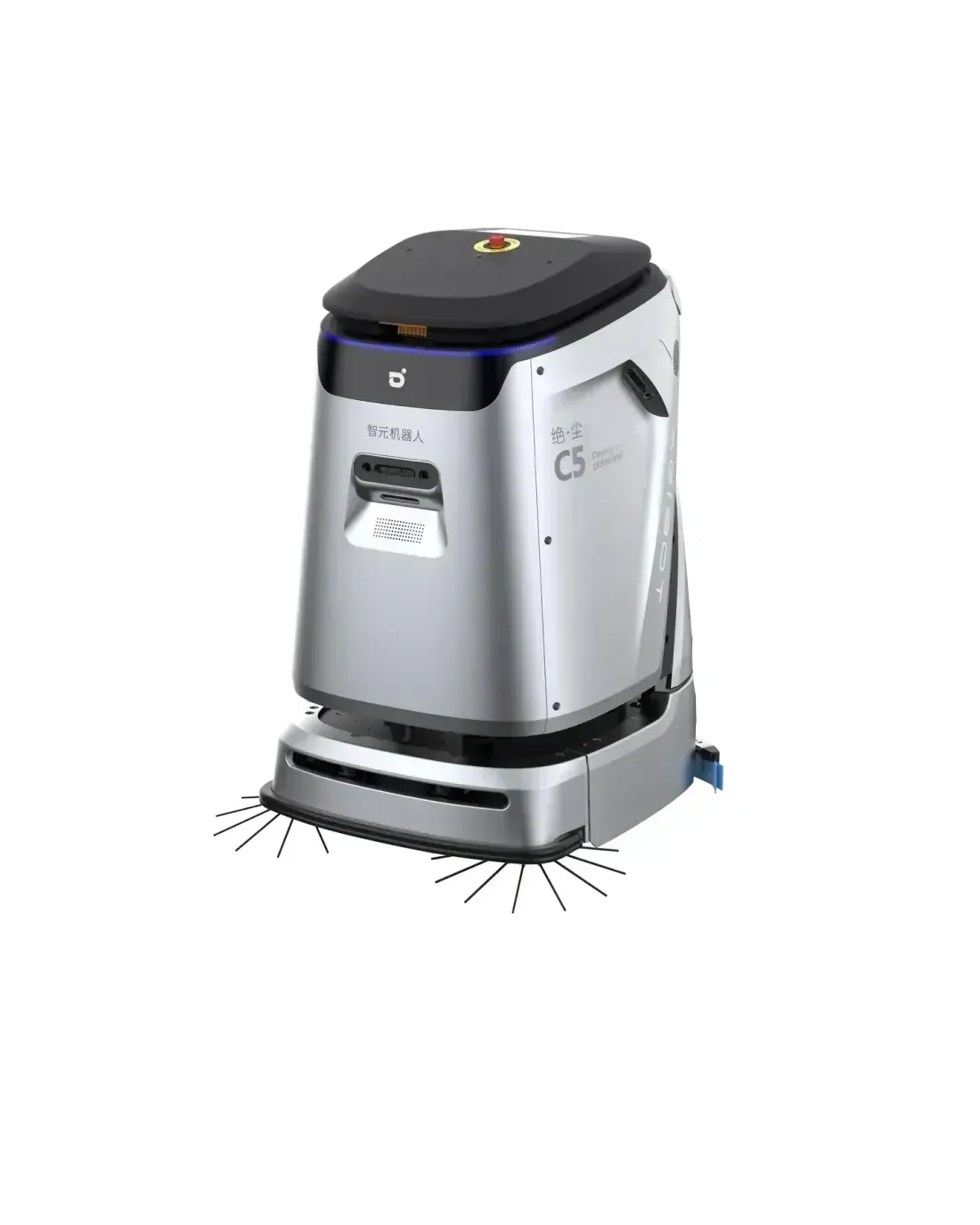
If you are looking for a cleaning robot for a factory floor, a large commercial complex, or a hospital, the AgiBot Juechen C5 (referred to here as the C5) is likely already on your shortlist. Its publicly available specifications are striking: 25 kg of downforce, a 90 L water tank, a nominal efficiency of 1,980 m²/h, and a three-part autonomy package covering automatic charging, automatic water refill/drainage, and self-cleaning of the recovery tank.
This report does not stop at the spec sheet. What determines the real experience with a cleaning robot is not the factory nominal figure, but whether deployment gets stuck on dock placement, mapping, and subsequent layout changes. The following sections cover product positioning, the deployment process, the three variables that determine workload, site fit, and an FAQ.
1. First, Understand Where the C5 Sits: It Is a Large Machine Built for Heavy Soiling
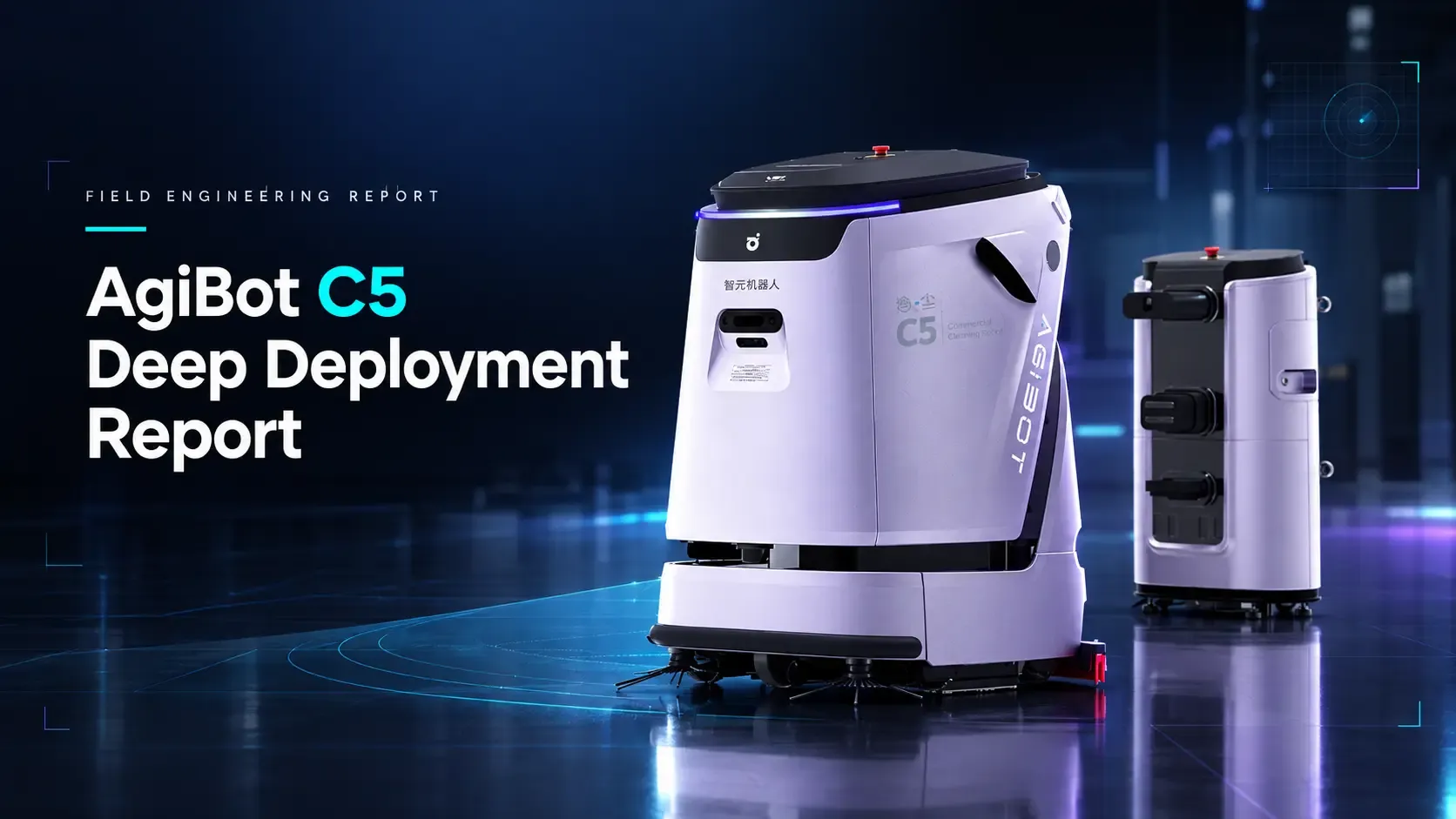
The C5 is AgiBot Robotics’ first intelligent cleaning machine aimed at mid-to-large sites. It combines sweeping, scrubbing, and dust mopping in one unit, targets hard floors, and is positioned for commercial complexes, factories, hospitals, and office buildings.
Taken together, the public specifications make the selection logic clear: the C5 trades large water volume and high downforce for heavy-soil cleaning capability, while large tank capacity and an automated workstation reduce the need for frequent manual intervention.
| Dimension | Public data | What it means |
|---|---|---|
| Downforce | 25 kg | Aimed at heavy soil such as oil, coolant residue, and tire marks; paying for high downforce in light-soil sites is not economical |
| Scrubbing width | 550 mm | Single-pass coverage width sets the upper limit of efficiency on large hard-floor areas |
| Nominal maximum efficiency | 1,980 m²/h | Hourly output for mid-to-large sites; actual values depend on site conditions |
| Tank capacity | 90 L | Fewer refill and drain cycles; combined with the workstation, enables longer unmanned windows |
| Scrubbing runtime | Approx. 3 h | In scrubbing mode; dust-mopping mode runs longer |
| Recovery-tank self-cleaning | 4 min | Executed automatically after workstation replenishment, reducing manual recovery-tank cleaning |
| Dimensions / weight | 680 × 520 × 1,330 mm / 170 kg | Large machine; aisle width and workstation location must be confirmed on site |
On price, the C5 comes in two configurations — the bare machine and the machine with a fully automatic workstation — and the project price varies with volume, service package and scope, so it is quoted per project. Note that the C5 is a large machine in both size and weight: it is not economical for a few thousand square metres of light soiling. Its home ground is heavy soil, large areas, and sites with a genuine need to replace manual labour.
On deployment scale, manufacturing customers have publicly reported volume deployments, but the customers, unit counts and efficiency figures belong to those projects and are not cited here. What a machine can replace depends on area, soil intensity, shift pattern and degree of autonomy; a single case is not a general expectation.
2. What Deployment Involves: Five Tasks, With Different Weighting for the C5
Deployment covers everything between delivery and the point where site staff can operate the machine unaided. Regardless of brand, it usually breaks down into five pieces: workstation siting and water/power connection, mapping, route and zone setup, trial runs and adjustment, and staff training.
What is different about the C5 is not an extra step, but the weight of the workstation. The C5 workstation handles automatic charging, automatic water refill and drainage, and recovery-tank self-cleaning. It is the precondition for unmanned operation. It needs permanent power; if automatic water refill and drainage are used, it also needs a water supply and a drain. An optional mobile water tank can avoid plumbing work, but refill and drainage still require manual involvement, and the degree of autonomy drops accordingly.
In other words: buying a C5 without the workstation water and power in place is buying a large scrubber that still needs frequent manual attention.
3. Three Variables That Determine Deployment Workload
Workstation location is the most underestimated variable in C5 deployment. It needs permanent power and must not be pushed aside by later traffic-flow changes; an automatic refill/drainage setup also needs water and drainage. Existing plumbing often determines where the workstation can go, and the workstation location in turn determines the round-trip distance and accessibility between the replenishment point and each cleaning zone.
Practical advice: mark candidate workstation positions on the floor plan during the site survey and clear them in advance with the people responsible for fire safety and circulation. Choosing a position on delivery day usually means choosing one that should already have been ruled out. An optional mobile water tank can serve as a transitional solution, but it changes “whether plumbing is connected”, not the fact that “the workstation still needs a fixed, powered location”.
4. Timeline From Delivery to Independent Operation
Day One: Delivery, Workstation Confirmation, Mapping, and First Task
First-day progress depends heavily on whether workstation power, water, and drainage were settled before delivery. If they were fixed during the survey, mapping, zoning, and the first task can be completed the same day; if water and power are only coordinated on delivery day, progress usually stalls at the workstation, not at the robot.
Another easily overlooked first-day step is obstacle-avoidance simulation and narrow-aisle verification. In the pharmaceutical workshop trial, a dedicated obstacle-avoidance simulation was included, and the C5 was verified for navigation and avoidance in narrow aisles with many equipment columns and frequent material-transfer carts. If your site has similar pinch points, run them on day one with real carts and real pedestrian flows rather than waiting until the formal schedule starts.
Week One: Corrections Under Real Shifts
Problems exposed in the first week are usually not “the robot cannot run”, but a cleaning window narrower than expected, the narrowest aisle narrower than the drawing, and replenishment round-trip time underestimated. The C5’s scrubbing runtime is about 3 hours, and the workstation’s automatic refill/drainage speed (fresh water 7–10 L/min, wastewater 10–15 L/min) determines the replenishment interval between cleaning segments. If site area and runtime do not match, either adjust zones and shifts, or add workstations or change the replenishment strategy. Fixing these within the first week is far cheaper than carrying them into formal operation.
5. How to Tell That C5 Deployment Is “Complete”
Three numbers are more reliable than “it looks like it is running smoothly”:
Coverage completion rate. The share of planned area actually completed per task. If it stays low, check workstation accessibility, aisle obstructions, and zoning before blaming robot capability.
Manual interventions per task. How often site staff have to step in. The C5’s automatic charging, refill/drainage, and recovery-tank self-cleaning are designed to push this number down; if it does not stabilise at a low level, there are still gaps in the workstation or the operating routine.
Consecutive weeks without supplier support. A full week of scheduled tasks completed independently by the site team is a clearer handover milestone than any verbal acceptance. Setting “one independent week” as the handover gate prevents deployment from drifting indefinitely in a “someone is still backing it up” state.
6. Who the C5 Fits — and Who It Does Not: A Site Comparison
The C5 is not a universal answer for all hard floors. It is aimed at heavy soil, mid-to-large areas, and a clear need to replace manual labour. Public deployment data also points mainly to manufacturing factories and industrial environments.
| Site | Fit | Basis |
|---|---|---|
| Factory floors (machining, automotive manufacturing, pharmaceutical outsourcing/warehousing) | High | 25 kg downforce plus large water volume targets oil, drug residue, and dust; the pharmaceutical workshop trial verified narrow aisles, dense columns, and material-cart traffic |
| Commercial complexes and large supermarkets | Medium-high | Matches the cleaning efficiency for large hard-floor areas, but cleaning windows and shelf-aisle widths must be confirmed; high downforce is redundant for light soil |
| Hospitals | Medium-high | Hard floors and night-time unmanned cleaning match the automatic workstation; obstacle response to beds, carts, and people must be verified |
| Office lobbies and public areas | Medium | Usable on large hard-floor areas, but a large machine is less manoeuvrable and less economical than a small machine for light soil |
| A few thousand square metres of light soil | Low | Size and weight are those of a large machine; bare-machine price and manoeuvrability do not match |
| Large carpeted areas, aisles narrower than the machine | Not suitable | The C5 targets hard floors; aisle width must be measured on site |
If the site is heavy-soil but small, the C5’s capability redundancy becomes cost redundancy. If the site is large but the soil is mainly dust and footprints, re-evaluate whether 25 kg downforce is necessary. The first screening criterion is not the brand, but three site facts: soil type + single-zone area + aisle width.
7. FAQ: Eight Questions About C5 Deployment and Operation
Q1: Does C5 deployment require an engineer to come on site for mapping?
The C5 supports automatic zoning and rapid map merging, and site staff can take part in mapping and task generation. However, first-time mapping and obstacle-avoidance verification for a large machine are usually guided by a technical team. The exact on-site scope depends on the service package in the purchase contract.
Q2: Must the workstation be connected to water and drainage?
The standard workstation supports automatic refill and drainage and therefore needs water connections. If site modification is difficult, an optional mobile water tank can avoid plumbing work, but refill and drainage still require manual involvement and the degree of autonomy is lower.
Q3: Is a 3-hour scrubbing runtime enough?
It depends on the single-zone area and the cleaning window. Three hours is the nominal runtime in scrubbing mode; with the workstation’s automatic refill/drainage, the practically usable continuous operating time depends on replenishment speed (fresh water 7–10 L/min, wastewater 10–15 L/min) and the distance to the workstation. For larger sites, measure “net cleaning time” during the trial rather than relying only on the nominal runtime.
Q4: Does a layout change require remapping?
The C5 supports automatic map updating and rapid merging of new areas, so a layout change can be handled in the mobile app without necessarily requiring a full remap. It is advisable to make a real layout change during the trial to verify that tasks remain sensible after the update.
Q5: Can the C5 work across floors?
The C5’s public capabilities include access-control and elevator integration, supporting cross-floor and cross-zone operation. The integration requirements for specific elevator brands and access-control systems must be confirmed during the survey.
Q6: Does the recovery tank really not need manual cleaning?
After replenishment, the workstation automatically performs about 4 minutes of recovery-tank self-cleaning, reducing the frequency of manual cleaning. But “reduced” does not mean “maintenance-free”: periodic inspection and consumable replacement still belong in the daily routine.
Q7: How many cleaners can one C5 replace?
Public reports do use “one machine replaces manual labour” to frame the benefit in a specific manufacturing customer scenario, but that is a conclusion under that customer’s site conditions, shifts, and cleaning standards. The number replaced depends on area, soil intensity, cleaning frequency, and degree of autonomy. A single case conclusion should not be treated as a general expectation.
Q8: How soon can the site run it independently after purchase?
If the workstation location and utilities are settled before delivery, mapping and the first task can be completed on day one. Independent operation by the site team is usually accepted on the basis of first-week corrections under real shifts plus one full week without supplier support. What slows progress is usually not the robot, but workstation utilities and aisle conditions.